Meridian Blueprint · Contract Brokering
Don't clean buildings. Broker the contracts.
A brokered contract needs no crew, no equipment and no payroll. What it does need is a vendor network secured before you sign anything — which is exactly where most people get it backwards.

New · Included free with your download
Now with a built-in AI assistant.
This edition ships with a private assistant built on this exact material. Ask a question in plain English — it answers from the guide and takes you straight to the right section. No searching, no subscription.
Ask in plain English
“Where do I start?” “How do I price this?” “Is this compliant?” — it answers from your material and points to the exact section.
100% offline & private
Runs entirely on your own computer. No account, no internet, no subscription — your questions never leave your machine.
Nothing to install
Runs on Windows: one double-click opens it in your browser. Built into your download at no extra cost.
The problem
Most people who try this accidentally start a cleaning company instead.
Four mistakes turn a brokerage into an operating business you never meant to own.
Signing contracts before securing vendors
The fastest way to end up doing the work yourself at a price you set for somebody else.
No escalation clause, no margin protection
Wages rise, your rate does not, and the spread you brokered disappears over the contract term.
The vendor discovers your markup
What happens next depends entirely on how the relationship was structured on day one.
One client is 60% of your revenue
Concentration risk that turns a good year into an existential one when a single contract ends.
Operations
Find the contracts before anyone else is bidding.
Where commercial cleaning contracts actually surface, how to qualify them quickly, and how to approach a facilities decision-maker who already has a provider.
The guide covers the sourcing method rather than a single list, because lists expire and methods do not.


Job economics
The bid is where the margin is decided.
Pricing a contract you will not service yourself means understanding the vendor's cost floor as well as the client's ceiling, and building the spread into the structure rather than hoping for it.
Escalation clauses are covered as structure, not as a template to copy blindly.
Miles' Reality Check
Things to consider before you start.
Know before you start
The vendor network comes first. Signing a contract you cannot staff is the defining failure mode of this business.
Common mistake
Brokering without margin protection. Multi-year contracts with rising labour costs erode a fixed spread to nothing.
Good fit / bad fit
A good fit if you are comfortable selling and negotiating. A poor fit if you would rather run operations than manage relationships.
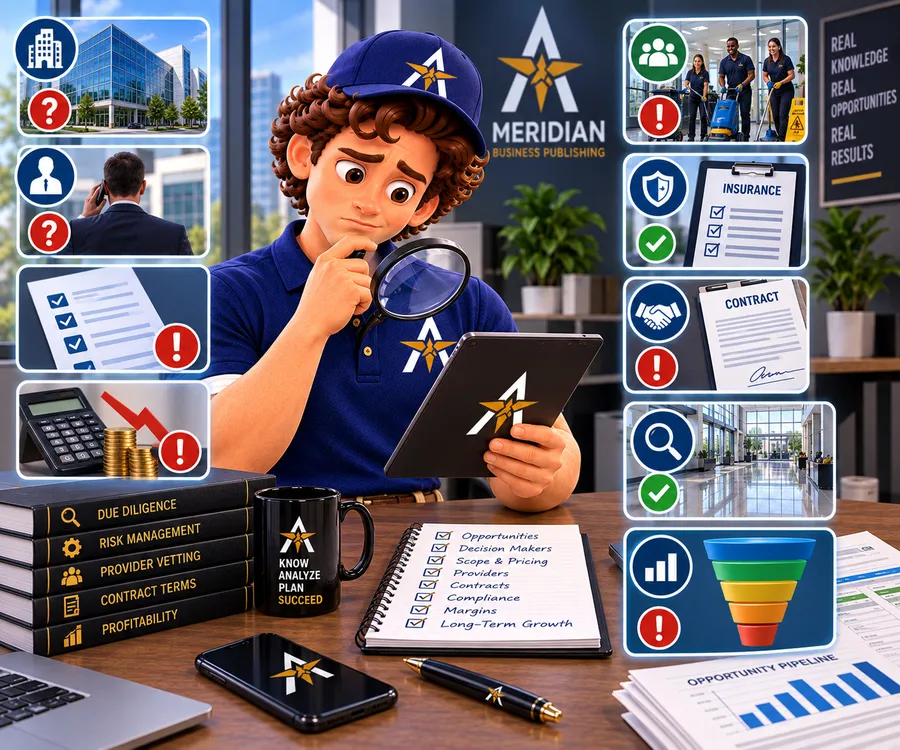
What's inside
Sourcing, structuring and protecting the spread.
- Formation and positioningHow to set up as a broker rather than an operator, and why the distinction matters legally.
- Building the vendor networkFinding, vetting and securing service providers before you need them.
- Contract prospectingWhere opportunities surface and how to qualify them fast.
- Bid and pricing analysisReading the vendor's cost floor and the client's ceiling, and pricing the spread.
- Structure and margin protectionEscalation, term and the clauses that keep the spread intact.
- Scaling the bookAdding contracts without adding concentration risk.

Before you decide
Take the brief first.
Not sure this is the one?
Take the one-page brief: all eight Meridian businesses, what each actually requires — capital, appetite for selling, whether you end up employing people — and the honest downside of every one. No pitch, and if you read it and none of them suit you, that is a useful answer.
One brief, plus the occasional Meridian note. Unsubscribe any time. We never sell your address.
The offer
One payment. The whole system.
Commercial Cleaning Contracts Broker is $39, delivered as a single document with the toolkit. No subscription and no upsell.

Commercial Cleaning Contracts Broker
$39
One payment. Instant download.
- Complete brokering system
- Vendor network build-out
- Bid and pricing analysis
- Margin protection structures
Secure checkout through Gumroad.