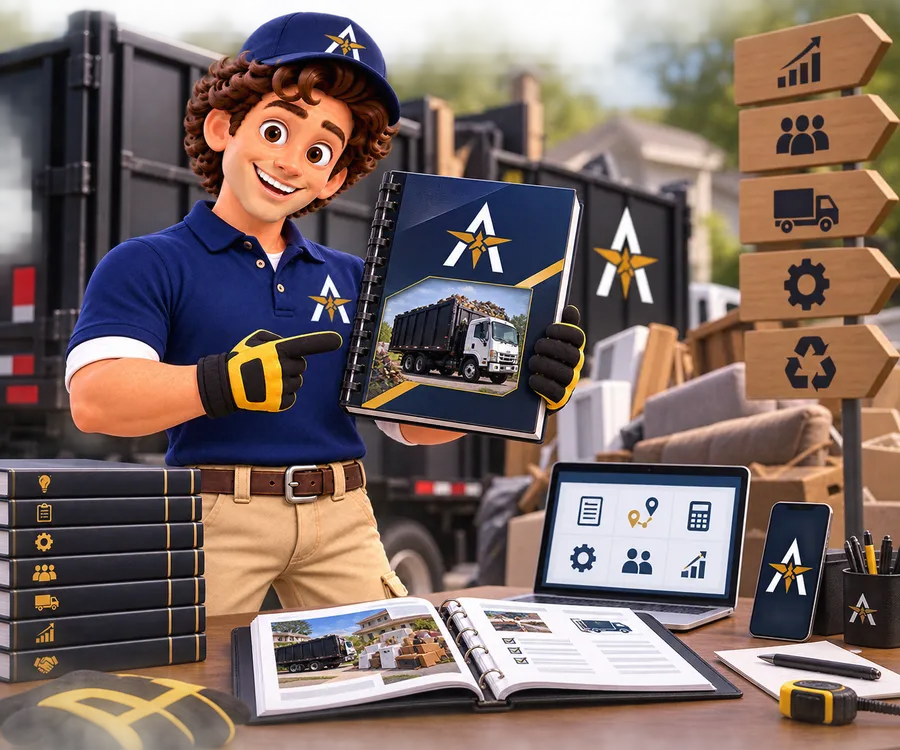
The gap between a $200K/year owner-operator working 60-hour weeks and a $2M/year company running four trucks and ten employees isn't harder work. It's the system. This is that system — from your first pickup-truck job to a multi-crew, multi-truck operation.
Not because the demand isn't there — it's a $10B+ industry that grows every year. The problem is everyone starts with a truck and a Facebook Marketplace ad, and the failure patterns are predictable.
Guessing at volume, ignoring weight, no fuel surcharge, no specialty-item pricing. Without a real pricing system, you're racing competitors to the bottom on margin you never had.
Scrap metal, e-waste, resellable furniture, and donation tax credits all left on the table. The real profit in this business is made in disposal decisions, not the pickup.
No SOPs, no hiring system, owner doing every job personally. That's a self-employment job with a truck payment, not a business — and it caps out well below six figures.
No COI, no hazmat awareness, no worker classification strategy. One bad job — a punctured pipe, an injured crew member, an illegally dumped mattress — and your business is one lawsuit from over.
Every one of these traps is preventable. They're all in this guide — named, documented, and paired with the exact system you use instead.
Growing 4–6% per year across ~20,000–30,000 mostly single-operator businesses. No company controls more than 5% of the market — wide open for systematic operators.
From industry overview and business formation through pricing, operations, disposal profit maximization, and multi-truck scaling — plus 8 bonus specialty chapters.
The included 90-Day Roadmap maps formation, first jobs, first commercial accounts, and your first hire — hour by hour, not "figure it out."
A 1-800-GOT-JUNK or College Hunks franchise costs $70,000–$200,000+ in fees alone — plus 7–12% of your gross revenue in perpetual royalties, forever. An independent operator can start for $5,000–$50,000 with zero royalties and an unlimited scalability ceiling — if they have the systems franchises are actually selling.
Aging homeowners downsizing, estates being settled, storage units going to auction, contractors generating debris, property managers turning over units, and disaster cleanup after every major storm. Every one of these is a recurring revenue channel — not a one-off.
A company doing $500,000/year in revenue at 20% disposal cost spends $100,000 on disposal. Drop that to 10% — through scrap metal, resale, and donation routing — and you keep an extra $50,000 in net profit on the exact same revenue. Same trucks, same jobs, same customers.
This is the mathematical reason junk removal supports both solo operators and multi-truck regional companies. The barrier isn't capital or licensing — it's knowing the pricing, disposal, and operational systems that separate a one-truck grind from a company a private equity roll-up wants to buy.
Not "buy a truck and figure it out." A structured sequence that ends with a systemized business, real commercial accounts, and your first hire.
LLC, insurance, DOT requirements, banking, and your first vehicle decision (pickup vs. dump truck vs. roll-off). Build your pricing sheet before your first job.
Google Business Profile, Facebook Marketplace, Nextdoor, and the 20+ residential/commercial lead sources from Section 5. First paying jobs booked and completed.
Cold call and email property managers, contractors, and estate attorneys using the provided scripts and templates. Sign your first recurring commercial contract.
Write your SOPs, stand up your KPI dashboard, and make your first hire using the hiring guide. By day 90, the business no longer depends entirely on you.
The Expert Playbook closes with three documented case studies — each one showing a different lever pulled to break past the one-truck ceiling. The numbers are theirs, not projections.
Started 2019 with $12K in savings and one F-350. Year 1: $85K revenue, solo grind, couldn't take a vacation. Pivoted to pursuing property management accounts in months 13–18.
"Residential junk removal is a treadmill. Commercial contracts are a foundation."
Faced brutal residential price competition starting in 2020. Invested $2,000 in a flatbed modification and a crew member dedicated to stripping copper, aluminum, and brass from every load before disposal.
"I figured out how to make my disposal cost a profit center. That changed everything."
Ran a standard $200K–$250K/year operation for 4 years. Eighteen months before Hurricane Ian, she got IICRC-certified, registered as a FEMA vendor, and built relationships with 3 insurance adjusters.
"That 18-month investment returned $340,000 in 60 days. No other marketing has ever come close."
12 core modules. 8 bonus chapters. A complete 12-part toolkit and an expert playbook. Built to be superior to franchise training manuals — and structured so you can execute on day one.
Industry overview, business models, formation, equipment, finding customers, pricing, operations, disposal & profit maximization, commercial contracts, legal, technology, and scaling — in order.
Estate cleanouts, hoarding cleanup, disaster recovery, construction debris, government contracting, storage lien sales, senior downsizing, and AI-powered automation — the highest-margin niches most operators never touch.
90-day & 1-year roadmaps, cold call scripts, email campaigns, pricing calculators, crew checklist, KPI dashboard, hiring guide, vendor directory, proposal template, safety inspection form, and annual financial model.
Landfill rate arbitrage (up to $38K/year in savings), pre-foreclosure outreach, a storage-facility relationship stack worth $2K–$8K/month, insurance Xactimate billing, municipal recycling incentives, commercial lease diversion, contractor materials recovery, and diversion credit marketing.
Kevin in Charlotte, Reginald in Detroit, Angela in Tampa — three documented paths from first truck to real revenue. See the numbers →
Volume pricing, weight pricing, hourly rates, specialty-item pricing, commercial contract pricing, emergency-job premiums, and fuel surcharges — stop guessing what to charge.
The 6-tier disposal hierarchy, landfill fee negotiation, scrap metal price guide (copper wire pays $2.50–$4.50/lb), appliance recycling, e-waste channels, furniture resale, and donation-receipt optimization. Where the real margin lives.
Contracts, liability, hazmat regulations, worker classification, environmental compliance, and collections. The section that keeps a bad job from becoming a business-ending lawsuit.
The 20 most common misconceptions that keep operators stuck, corrected one by one, plus quick-reference tables you'll come back to long after the first read.
No subscription. No upsells. No drip-fed modules. Pay once. Get everything. Start executing today.
Secure checkout · Card, Apple Pay, Google Pay · Instant delivery
Requirements vary by state and municipality — most areas require a general business license and, depending on your vehicle and volume, a DOT number. Some hazardous or C&D loads require separate hauling permits. Section 3 (Business Formation) and Section 10 (Legal) walk through exactly what to check in your area.
The entire curriculum, bonus chapters, toolkit, and expert playbook are delivered as a single comprehensive .docx document — easy to read on any device and to reference on the job.
No. The guide covers 12 different business models — including commercial contracts, estate cleanouts, hoarding cleanup, storage lien sales, construction debris, disaster recovery, and government contracting — each with its own playbook.
No. Section 4 (Equipment) compares pickup truck + trailer, dump truck, and roll-off setups by cost and job type, so you can start with what you can afford and upgrade as revenue justifies it.
Most operators following the 90-Day Roadmap book their first jobs within the first two weeks using free channels — Google Business Profile, Facebook Marketplace, and Nextdoor — while formation paperwork is still in progress.
Franchise training programs and business consultants charge thousands for a comparable operating system — plus ongoing royalties. This guide gives you the entire system once, at a price that doesn't require your first three jobs just to break even on the education.
Yes. This is Edition 2026.1. As disposal regulations, recycling incentives, and platform tools change, updated editions will be pushed at no extra cost. You're buying into the system, not a static document.
Every week you spend guessing at pricing and dumping resellable loads at the landfill, another operator in your market is signing the commercial accounts and hiring the crew that should have been yours.
Get Instant Access — $29Instant download · One-time payment · All content included